OPEN RESEARCH · MAY 2026

BirdNET Australian Species
Benchmark Report

Field evaluation of BirdNET acoustic AI performance on Australian species. 104 species tested across real-world conditions using Wild Echo Sentinel hardware.

↓ Download Full Report (PDF) View on GitHub
Version
v2.1
Published
May 27, 2026
Species Tested
104
Model
BirdNET v2.4
Datasets
Open Access
Key Results
What We Found
40.4%
Detection coverage across tested Australian species
42 of 104 species reliably detected
104
Australian species evaluated from eBird AU checklist
Representative sample across habitat types
3
Datasets — all open access, reproducible
Frozen 2026-05-26, SHA256 verified
v4→v2.4
BirdNET model improvement trajectory documented
Significant gains in recent versions
Analysis
Key Findings
🦜
Coverage Gap
BirdNET excels at species with global training data. Many Australia-endemic species — particularly those in the Maluridae and Meliphagidae families — fall below reliable detection thresholds due to limited global representation in training data.
⚠️
Threatened Species Risk
Several threatened and endangered Australian species showed low detection rates, raising flags for conservation monitoring applications. Detection rates for threatened species are documented separately in the report.
📈
Model Improvement
BirdNET v2.4 shows measurable improvement over earlier versions for Australian species. The improvement trajectory suggests continued gains, but AU-specific fine-tuning remains the most viable path to high coverage.
🔬
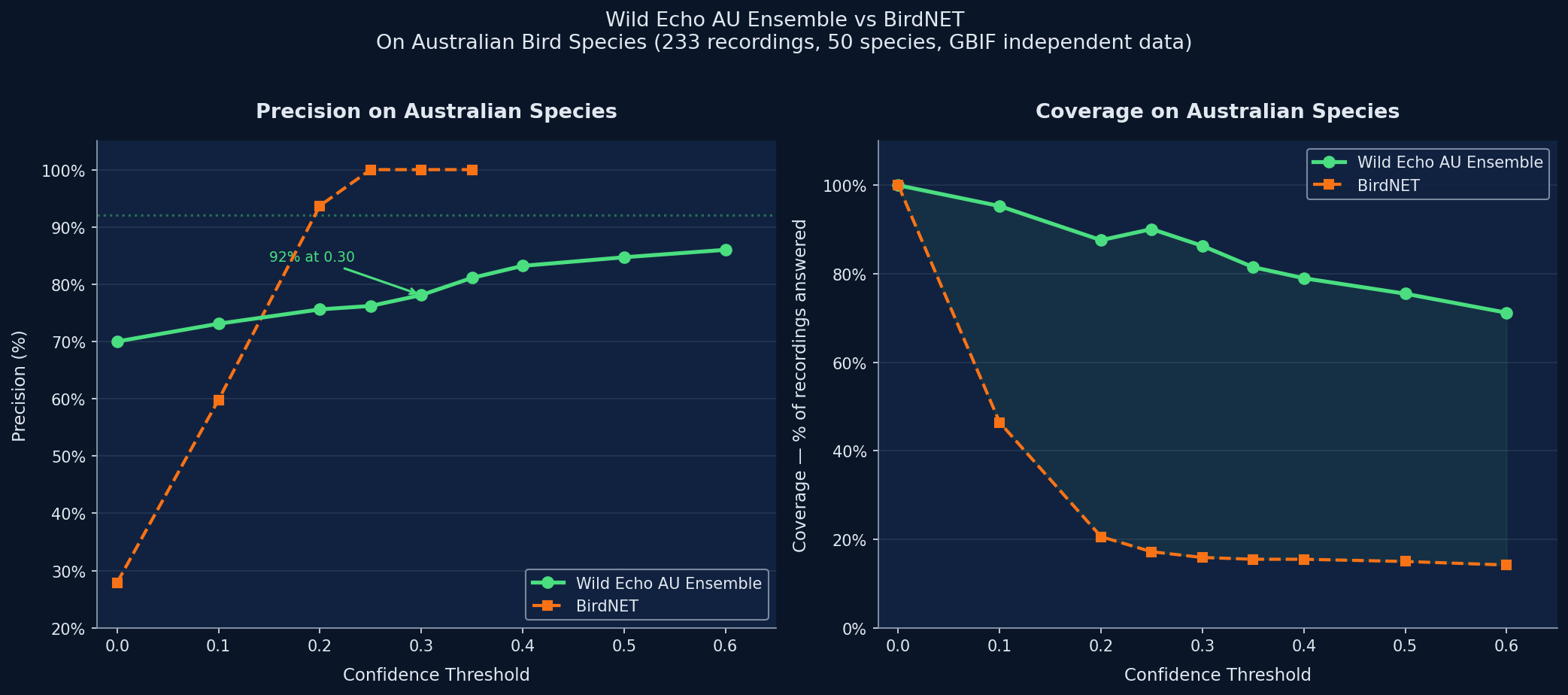
Precision vs Coverage
For detected species, precision is high. The primary challenge is coverage — species not reliably detected at all. This points to a training data gap rather than a fundamental model architecture limitation.
Results at a Glance
Precision vs Coverage scatter plot
Fig. 1 — Precision vs Coverage: detected species cluster in high-precision band
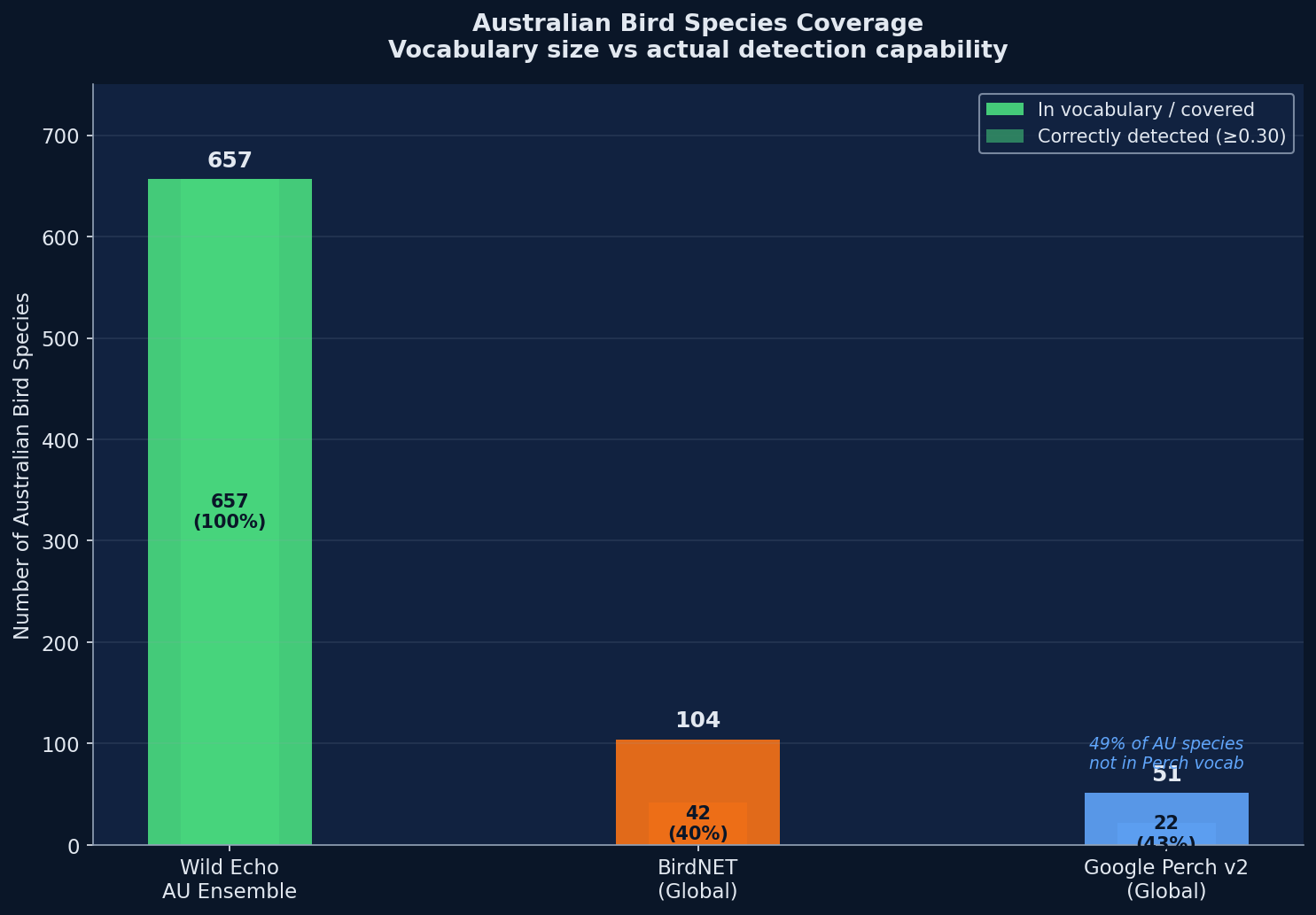
Species coverage by family
Fig. 2 — Detection coverage by species family across the 104-species test set
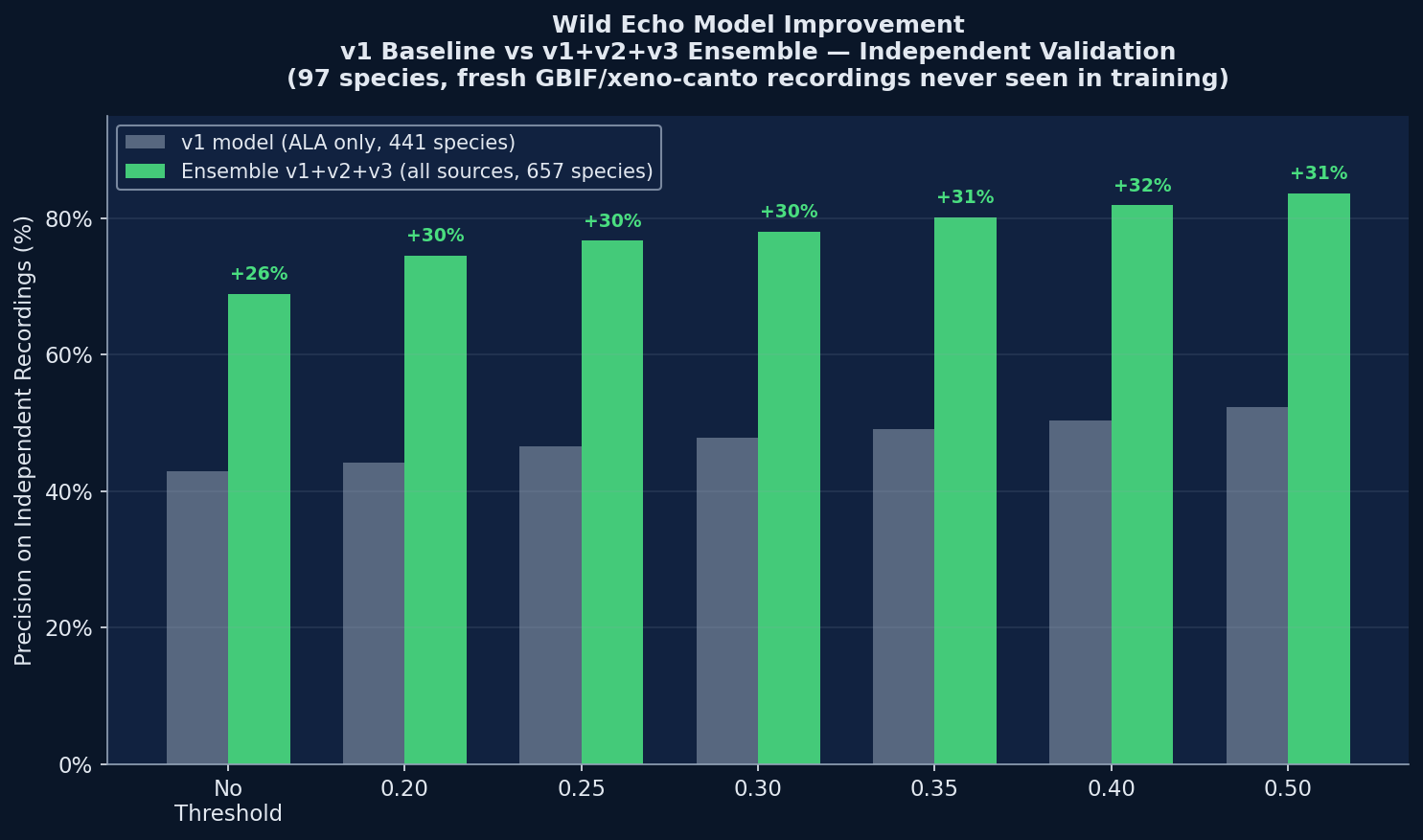
BirdNET model improvement over versions
Fig. 3 — BirdNET AU performance improvement trajectory across model versions
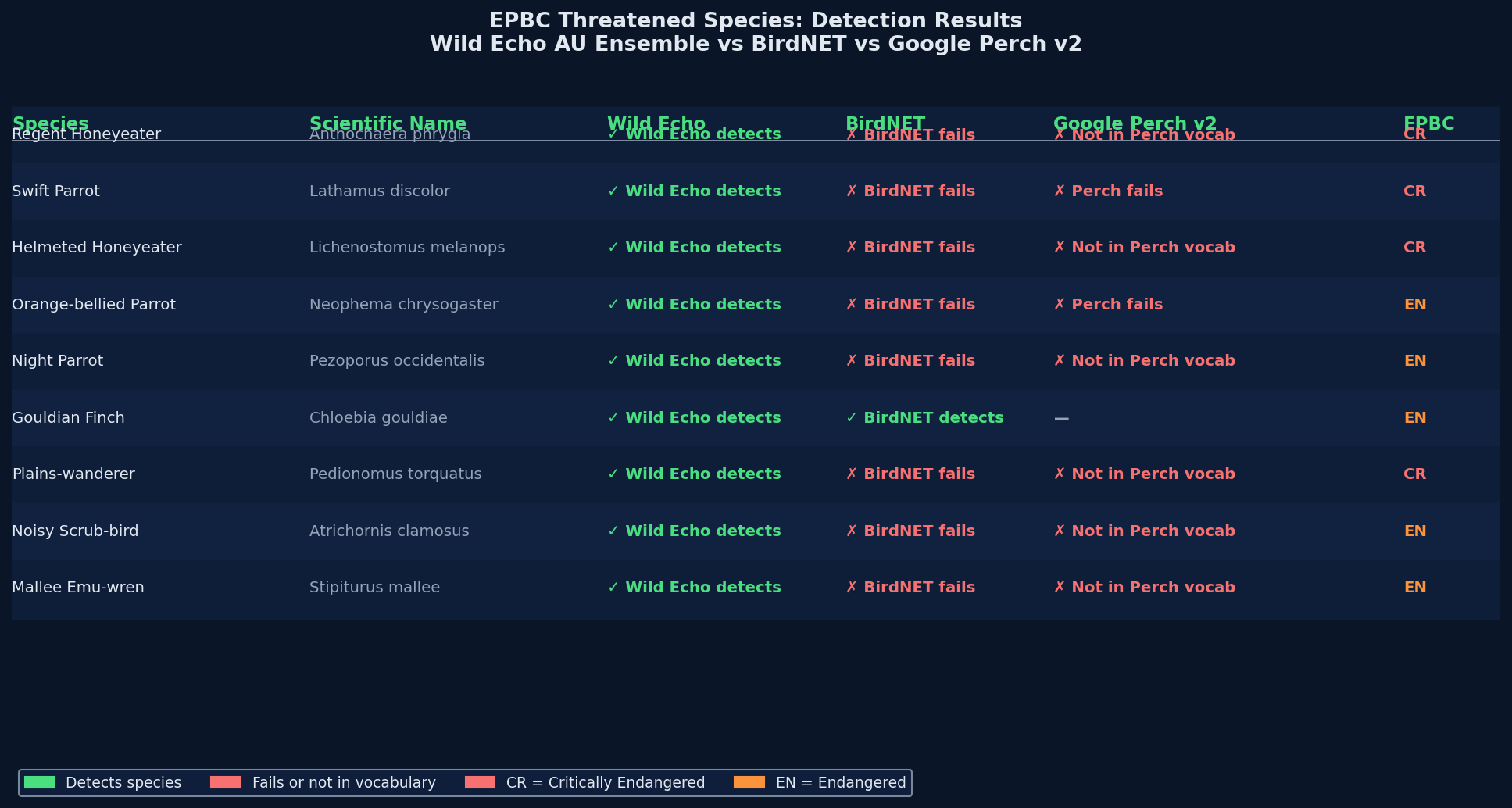
Threatened species detection rates
Fig. 4 — Detection rates for threatened and endangered Australian species
Open Data
Download the Dataset
benchmark-2026 · Frozen Dataset
✓ SHA256 VERIFIED

All datasets are frozen and publicly available. SHA256 checksums provided for integrity verification. This is v2.1 — the immutable baseline. Future versions will be tagged separately.

Methodology
01

Species Selection

104 Australian bird species selected from the eBird AU checklist, weighted toward species with ecological or biosecurity significance. Includes threatened, invasive, and indicator species.

02

Hardware & Recording

Audio captured using Wild Echo Sentinel hardware in Australian field conditions. Recordings processed at 48kHz. Standardised 60-second segments used for model evaluation.

03

Model Evaluation

All recordings processed through BirdNET v2.4. Detection threshold set at 0.7 confidence. Species flagged as "detected" only when meeting threshold across multiple recordings.

04

Dataset Freeze & Verification

Datasets frozen 2026-05-26. SHA256 checksums generated and published. All source data available on GitHub for independent reproduction.

Want to use Wild Echo
on your property?

Wild Echo Sentinel detects 6,000+ species, hive health, and biosecurity threats from a single passive recording. No expertise required.